Saturday, July 13, 2019

2019 EMCA Distinguished Book Award


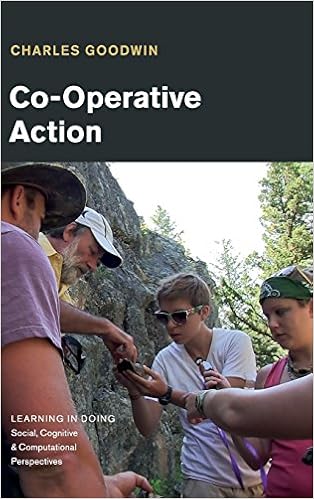
The committee for the 2019 EMCA Distinguished Book Award, consisting of Jason Turowetz, Donald Everhart, and Waverly Duck, has unanimously selected Charles Goodwin as this year’s recipient for his book, Cooperative Action (Cambridge University Press, 2017). The committee chose Dr. Goodwin’s book for its outstanding contributions to the field of ethnomethodology and conversation analysis. The book represents the culmination of the late Dr. Goodwin’s decades-long scholarship in EMCA, applied linguistics, and anthropology, and ties together all of his work, from his earliest research on collaborative sentence construction and argumentation to his pathbreaking studies of interaction and disability, professional vision, embodied and multimodal action, and archaeological practice. 

At the center of the book is Goodwin’s argument that cooperative action is the cornerstone of human culture and social order, providing “in the midst of action itself, a systematic mechanism for progressive accumulation with modification from all scales, from chains of local utterances, through tools, to the unfolding differentiation through time of human social groups” (2017:1). Drawing on materials from a range of fields, including evolutionary biology, anthropology, sociology, archaeology, linguistics, and psychology, Goodwin addresses big questions that cut across disciplinary boundaries as he makes the case for an interaction-centered theory of human society. In particular, he shows how actors build courses of action by using and modifying resources created in previous interactions, and how local actions are implicated in the continual making and remaking of culture. His book puts EMCA in dialogue with scholars in the social and natural sciences, articulating a “general mechanism…for both accumulation and incremental change, one lodged within the interstices of mundane action itself” (2017:7) and challenging popular alternatives that reduce social behavior to psychological and/or biological processes. 

Goodwin’s impressive book will no doubt serve as a resource and inspiration for current and future generations of EMCA scholars.

2019 EMCA Graduate Student Paper Award


Congratulations to Alexandra Tate on the award for best student paper for her “Treatment Recommendations in Oncology Visits: Implications for Patient Agency and Physician Authority,” published in Health Communication, 2018.

This study provides an exemplar of medical CA at its best; it provides new insights into how doctor-patient interaction varies across stages of the oncology encounter. The crucial question asked by Tate is how physician-oncologist and patient negotiate decision making for treatment and, in particular, how physicians assert their authority — and balance it with an orientation to the patient’s agency — in oncology regarding treatment. Making use of Stivers’ typologies for primary care treatment recommendations, Tate found that while oncologists’ proposals were most common in the initial stage of oncologist/patient interaction, when the oncologist needed the patient to buy into a certain treatment, during other stages (mid-course treatment and ancillary treatments) pronouncements were made. Differentiated forms of verbal action are accounted for with respect to the trajectory of the voyage of cancer treatment. A deviant case provides insight into the importance of the relationship of doctor and patient regarding how negotiation proceeds; when a relationship is new midcourse of treatment, then the oncologist must work to gain the acceptance of the client, and will not make pronouncements. The careful design of the study permitted such nuanced understandings of changes in doctor/patient medical encounters across time within a context in medical conversation analysis (oncology) which has received less attention than primary care.

There are important policy implications for medical care which result from this study. In the US physicians initially seek patients’ acceptance of treatment, and therefore want the patient’s input. However, having obtained their signing onto cancer treatments, physicians in the mid course context view patient agency as having been somewhat transferred to them. Participants then have little opportunity to consider alternative therapies, stop treatment or shift to palliative or supportive care. The paper makes important points in showing how this happens and, implicitly, in providing for opportunities to medical staff to become aware of opportunities to enhance the patient’s participation.

Marjorie Goodwin, Lorenza Mondada and Anssi Peräkylä

2019 Garfinkel-Sacks Award for Distinguished Scholarship


The award committee—Mardi Kidwell, Kevin Whitehead and Geoff Raymond—and section officers would like to congratulate Gene Lerner on the Garfinkel-Sacks Award for Distinguished Scholarship. 


Here are some excerpts from letters of recommendation:

Across a career spanning more than three decades, Gene’s published work has served as a model of analytic rigor and creativity that has made groundbreaking and cross-cutting contributions to virtually every core area of conversation analysis. These include, among others, a number of important elaborations of Sacks, Schegloff, and Jefferson’s pioneering specifications of the turn-taking system for conversational interaction, as well as foundational studies of grammar in interaction, conversational repair, and video studies of embodied conduct. In addition, his work has provided advances and interactional re-specifications of numerous other areas of sociological inquiry, as seen, for example, in his connection of Goffman’s concept of “face” to the interactional organization of preference structures, and in his collaborative contributions to an innovative and wide-ranging project examining the social lives of very young children. 

Gene's research career has been both innovative and exemplary: Innovative both in the traditional sense of opening up new and difficult areas of investigation, but also in a second sense of seeing important lacunae in the classically great papers of conversation analysis on topics like turn-taking and repair, developing the relevant issues, and in the process returning the classic topics themselves to the agenda of active CA research. Gene has never seen the classic papers as 'tablets of stone,' but rather as active and central research sites for on-going investigation. Gene's research is exemplary in its meticulous conceptualization, and in the deep reservoir of craft-skills with which he pursues empirical findings. There are few researchers who are more careful in the use of words than Gene, nor more exact in the instantiation of his conceptualizations with empirical data. His is a most notable career which we all do well to celebrate.

Wednesday, May 29, 2019

The Summer 2019 Newsletter is Now Available!

The Summer 2019 edition of our ASA section newsletter is now available to view and download here. This summer, we're heading to New York for two weekend days of sessions and meetings.

In this issue:

  • A message from co-chairs Morana Alač and Anne Rawls
  • Our section's full conference schedule, including paper abstracts. You can also view the schedule on this page of our blog.
We have several suggestions for possible places to visit and shows to take in together in the newsletter, but welcome further suggestions. Check out the Chair's message to see what we have planned and email Morana if you have further recommendations!

And remember: contact newsletter editor Don Everhart if you would like to be featured in the next edition. His email is enclosed in the newsletter. We welcome announcements, reports, graduate student profiles, and all your EMCA news.

Saturday, March 9, 2019

Call for Nominations for Section Awards at ASA 2019

Garfinkel-Sacks Award for Distinguished Scholarship 

This award recognizes those who have made distinguished lifetime career contributions to the fields of ethnomethodology and/or conversation analysis.

To nominate an individual for this award, please submit the following:

1) A letter detailing the nominee's contributions to EMCA;
2) Relevant supporting materials, including a list of the nominee's publications;
and
3) At least two additional external letters speaking to the person's contributions and impact on the field(s)

Please send nominations to Morana Alac (Section co-chair) (malac@ucsd.edu) by April 15.


EMCA Distinguished Book Award 

This award recognizes an outstanding publication contributing to ethnomethodology and/or conversation analysis. The 2019 award will be given to a book. Eligible books for the 2019 award must be published between September 1, 2016 and February 28, 2019, inclusively. Authors can submit their own publications, or nominations can be made on their behalf. Committee members may also make their own nominations.

Nominations should include:

1) full bibliographic information on the nominated publication;
and
2) a PDF copy (preferable) or a hard copy of the article, chapter or book; or a link to a web site where the article, chapter or book can be downloaded in full at no charge.

Please send nominations to Morana Alac (Section co-chair) (malac@ucsd.edu) by April 15.


EMCA Graduate Student Paper Award 

This award recognizes an outstanding publication contributing to ethnomethodology and/or conversation analysis. The 2019 award will be given to a paper. Eligible papers for the 2019 award must be published between March 30, 2017 and February 28, 2019, inclusively. Authors can submit their own publications, or nominations can be made on their behalf. Committee members may also make their own nominations.

Please send nominations to Morana Alac (Section co-chair) (malac@ucsd.edu) by April 15.

Tuesday, December 11, 2018

EM/CA Section Newsletter and Communication from Co-Chairs

Greetings from your new Co-Chairs, Morana Alač and Anne Rawls.

The attached newsletter announces the sessions for the 2019 meetings in New York, explains the Sessions, and encourages everyone to submit. The submissions portal is now open and will close on January 9th at 11:59 PM. We are looking forward to lots of interesting submissions and a great meeting and party in New York City next summer. Please anyone with news or other content for the newsletter get it to us. We plan to publish another newsletter next spring.

Sincerely,
Anne Rawls and Morana Alač

Wednesday, August 8, 2018

The Summer 2018 Newsletter is Now Available!

The Summer 2018 edition of our ASA section newsletter is now available to view and download here. We look forward to seeing you in Philadelphia soon!

In this issue:

  • A message from co-chairs Ken Liberman and Aug Nishizaka, including the results of our latest election. Please welcome incoming co-chairs Anne Warfield Rawls and Morana Alač!
  • Our 2018 award winners, including Charles Goodwin for the EMCA Garfinkel-Sacks Award for Distinguished Scholarship; Kevin A. Whitehead and Edward Reynolds, for the EMCA Best Paper Award; Amanda McArthur for the EMCA Graduate Student Paper Award; and Darin Weinberg for the Melvin Pollner (1940-2007) Prize in Ethnomethodology. Read the statements from our awards committees and find links to the recognized papers and books.
  • Some remarks on Doug Maynard's 2018 Cooley-Mead Award.
  • Patrick Watson's report on the New Directions in Ethnomethodology Workshop.
The newsletter is also more interactive than usual. If you would like to email someone, click on their address. If you want to jump to a page from the table of contents, click on the page or the item. And if you want to pull up our section's award-winning papers and books, click through to them.

Enjoy! And remember: contact newsletter editor Don Everhart if you would like to be featured in the next edition. His email is enclosed in the newsletter. We welcome announcements, reports, graduate student profiles, and all your EMCA news.